
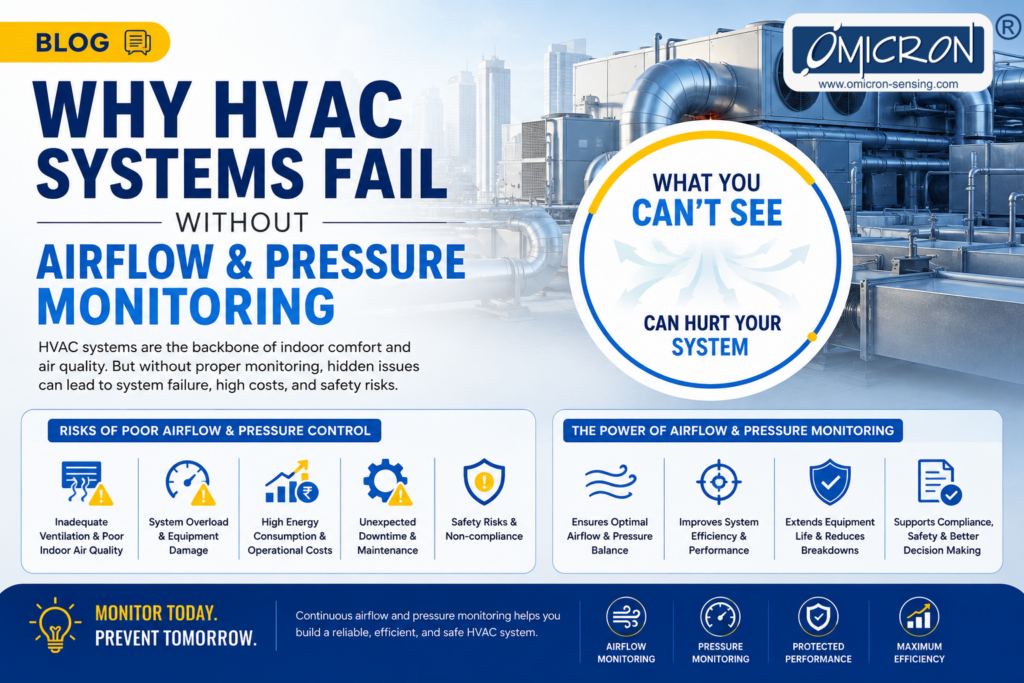
Heating, Ventilation, and Air Conditioning (HVAC) systems play a critical role in maintaining comfortable, healthy, and energy-efficient indoor environments. Whether in commercial office buildings, hospitals, manufacturing facilities, shopping malls, hotels, or data centers, HVAC systems are responsible for regulating temperature, humidity, air quality, and ventilation to ensure optimal conditions for occupants and equipment alike.
However, many organizations make substantial investments in HVAC equipment such as chillers, air handling units (AHUs), fans, ducts, and control systems while overlooking one of the most important aspects of long-term HVAC performance: monitoring. A well-designed HVAC system can only perform effectively when airflow and pressure conditions are continuously measured and maintained within intended operating parameters.
In reality, many HVAC failures do not originate from major equipment breakdowns. Instead, they begin with invisible issues such as inadequate airflow, clogged filters, pressure imbalances, blocked ducts, or improperly functioning dampers. Because these problems develop gradually and often go unnoticed, they can silently reduce system efficiency, increase energy consumption, compromise indoor air quality, and shorten equipment lifespan.
Poor airflow and pressure control can lead to occupant discomfort, rising utility costs, inconsistent temperatures, contamination risks, and non-compliance with industry standards. In critical environments such as hospitals, cleanrooms, and laboratories, the consequences can be even more severe.
This is why HVAC airflow monitoring and differential pressure monitoring have become essential components of modern building management. By providing real-time visibility into system performance, these monitoring solutions help facility managers identify issues early, optimize energy efficiency, maintain indoor air quality, and ensure reliable HVAC operation throughout the lifecycle of the system.
Why HVAC Airflow and Pressure Monitoring Systems Often Fail Despite Modern Equipment?
One of the most common misconceptions in facility management is the belief that installing high-quality HVAC equipment automatically guarantees long-term performance and efficiency. While modern chillers, AHUs, VAV systems, and advanced control platforms offer impressive capabilities, they cannot operate optimally without accurate monitoring and performance verification.
Many building owners focus heavily on selecting premium HVAC equipment during the construction or upgrade phase but invest comparatively little in monitoring infrastructure. As a result, the system operates without sufficient visibility into critical parameters such as airflow rates, duct pressure, filter condition, and ventilation performance.
Even the most advanced HVAC system can suffer from reduced efficiency if airflow distribution becomes unbalanced or pressure conditions drift outside design specifications. Monitoring is therefore not an optional add-on but a fundamental requirement for maintaining HVAC performance over time.
HVAC Systems Are Dynamic Environments
Unlike static mechanical systems, HVAC environments are constantly changing. System performance is influenced by numerous operational and environmental factors that evolve throughout the day and across seasons.
Some of the most common variables include:
- Changing building occupancy levels
- Seasonal temperature and humidity variations
- Filter loading caused by dust accumulation
- Duct contamination and blockage
- Fan performance degradation
- Aging motors and mechanical components
- Frequent space reconfiguration in commercial buildings
As these variables change, airflow patterns and pressure conditions also change. A system that was perfectly balanced during commissioning may gradually drift away from its intended operating conditions over months or years of operation.
Without continuous monitoring, facility teams often have no visibility into these performance changes until they begin affecting occupants or equipment.
Why Invisible Problems Go Undetected
One of the biggest challenges in HVAC management is that airflow and pressure problems are largely invisible. Unlike a leaking pipe or a failed motor, airflow deficiencies cannot be observed directly.
A reduction in airflow may develop gradually as filters become clogged or ducts accumulate debris. Similarly, pressure imbalances often emerge slowly due to fan wear, damper malfunctions, or changes in building usage patterns.
Because these issues evolve over time, they frequently remain unnoticed until symptoms appear, such as:
- Hot and cold spots within the building
- Poor ventilation
- Increased energy bills
- Excessive equipment runtime
- Indoor air quality complaints
- Unexpected equipment failures
By the time these symptoms become visible, the underlying problem may have already affected system efficiency, occupant comfort, and equipment reliability for an extended period. Continuous airflow and pressure monitoring helps detect these hidden issues before they escalate into costly operational problems.
The Critical Role of Airflow in HVAC Performance
-
What Airflow Means in an HVAC System
Airflow is the foundation of HVAC operation. Regardless of how advanced the cooling or heating equipment may be, conditioned air must be distributed effectively throughout the building to achieve the desired environmental conditions.
Several airflow streams work together within an HVAC system:
-
Supply Air
Supply air refers to conditioned air delivered by the HVAC system into occupied spaces. It is responsible for maintaining desired temperature and humidity levels.
-
Return Air
Return air is the air extracted from occupied spaces and sent back to the AHU for reconditioning or recirculation.
-
Fresh Air
Fresh outdoor air is introduced into the system to maintain adequate ventilation and indoor air quality. Proper fresh air intake is critical for occupant health and regulatory compliance.
-
Exhaust Air
Exhaust air removes contaminants, odors, moisture, and stale air from the building environment.
Proper management of these airflow streams ensures balanced ventilation, efficient heat transfer, and comfortable indoor conditions.
Why Proper Airflow Is Essential
Maintaining correct airflow is essential for several aspects of HVAC performance.
-
Heat Transfer Efficiency
HVAC equipment relies on airflow to transfer heating or cooling energy throughout the building. Insufficient airflow reduces heat exchange efficiency and forces equipment to work harder.
-
Temperature Consistency
Proper airflow ensures even distribution of conditioned air, preventing hot and cold spots across different areas of a facility.
-
Occupant Comfort
Comfort depends not only on temperature but also on adequate air circulation. Poor airflow often leads to stuffiness, uneven cooling, and occupant dissatisfaction.
-
Ventilation Effectiveness
Adequate airflow ensures that fresh outdoor air reaches occupied spaces while contaminants are effectively removed.
Airflow’s Impact on Energy Consumption
Airflow has a direct impact on HVAC energy performance.
When airflow drops below design levels:
- Fans consume more energy trying to maintain performance.
- Chillers and cooling systems operate for longer durations.
- Heating systems become less efficient.
- Equipment cycles increase unnecessarily.
In many commercial buildings, airflow deficiencies can significantly increase annual operating costs.
Continuous HVAC airflow monitoring allows facility managers to identify inefficiencies before they result in excessive energy consumption.
Airflow’s Role in Indoor Air Quality (IAQ)
Indoor air quality has become a major concern for modern buildings, particularly after increased awareness of airborne contaminants and ventilation requirements.
Proper airflow contributes to IAQ by supporting:
-
Fresh Air Circulation
Ensures adequate outdoor air reaches occupied zones.
-
CO₂ Management
Maintains acceptable carbon dioxide concentrations and prevents stale indoor environments.
-
Removal of Contaminants
Helps remove:
- Dust particles
- Airborne pathogens
- Volatile organic compounds (VOCs)
- Odors
- Excess humidity
Poor airflow can quickly compromise indoor air quality, negatively affecting occupant health, comfort, and productivity.
Industries Where Airflow Monitoring Is Critical
While airflow monitoring benefits virtually every building, certain industries depend on it for operational continuity and compliance.
-
Commercial Offices
Maintain employee comfort, productivity, and ventilation standards.
-
Hospitals
Support infection control, isolation areas, operating rooms, and patient safety.
-
Data Centers
Prevent overheating of mission-critical IT infrastructure.
-
Pharmaceutical Facilities
Maintain validated airflow conditions required for manufacturing compliance.
-
Manufacturing Plants
Control temperature, contaminants, and worker safety across production environments.
The Importance of Pressure Monitoring in HVAC Systems
Pressure is one of the most important indicators of HVAC system health and performance.
-
Static Pressure
Static pressure refers to the resistance that airflow encounters while moving through ducts, filters, coils, and other HVAC components.
-
Differential Pressure
Differential pressure measures the pressure difference between two points within a system. It is commonly used to assess filter condition, duct performance, and room pressure relationships.
-
Positive Pressure
A positively pressurized room contains higher air pressure than surrounding spaces, preventing contaminants from entering.
-
Negative Pressure
A negatively pressurized room maintains lower pressure than adjacent areas, preventing contaminants from escaping.
These pressure relationships are essential in healthcare, pharmaceutical, and laboratory environments.
Why Pressure Monitoring Matters
Pressure monitoring provides valuable insights into HVAC system performance.
-
Controlled Airflow
Pressure measurements help ensure that airflow is moving through the system as intended.
-
Proper Ventilation
Maintaining correct pressure relationships supports effective ventilation and air exchange.
-
Equipment Protection
Pressure monitoring helps identify developing issues before they damage fans, filters, or other HVAC components.
Critical Areas Requiring Pressure Monitoring
Several environments depend heavily on precise pressure control.
-
Cleanrooms
Prevent contamination and maintain product quality.
-
Operation Theatres
Control airborne infection risks during medical procedures.
-
Isolation Rooms
Protect healthcare workers and patients by controlling airflow direction.
-
Laboratories
Contain hazardous substances and maintain safe working conditions.
-
Server Rooms
Support reliable cooling performance for critical IT infrastructure.
How Pressure Imbalances Develop
Pressure problems can originate from multiple sources.
-
Dirty Filters
As filters become clogged, resistance increases and differential pressure rises.
-
Fan Degradation
Wear and tear can reduce fan performance and disrupt airflow balance.
-
Blocked Ducts
Obstructions create pressure losses and restrict airflow.
-
Damper Failures
Improperly functioning dampers can alter pressure relationships throughout the system.
Without monitoring, these issues may remain hidden until they significantly affect performance.
Real Consequences of Pressure Failure
Pressure failures can have serious operational consequences.
-
Contamination Risks
Incorrect pressure relationships may allow contaminants to enter controlled environments.
-
Poor Occupant Comfort
Pressure imbalances often lead to inconsistent temperatures and inadequate ventilation.
-
Compliance Failures
Industries such as healthcare and pharmaceuticals must maintain documented pressure conditions to meet regulatory requirements.
Failure to maintain proper pressure control can result in audits, penalties, and operational disruptions.
Common Problems Caused by Poor Airflow and Pressure Control
Poor airflow and pressure management can affect nearly every aspect of HVAC performance.
-
Uneven Cooling and Heating
Improper airflow distribution often creates hot and cold zones throughout a facility.
-
Excessive Energy Consumption
HVAC equipment consumes more energy when airflow conditions are outside design specifications.
-
Poor Indoor Air Quality
Insufficient ventilation allows pollutants and contaminants to accumulate indoors.
-
Occupant Comfort Complaints
Employees, patients, customers, and tenants quickly notice temperature inconsistencies and stale air conditions.
Frequent HVAC Equipment Breakdowns
Continuous operation under improper airflow and pressure conditions accelerates equipment wear.
-
Shortened Filter Life
Restricted airflow causes filters to load faster and require more frequent replacement.
-
Excessive Fan Wear
Fans often compensate for airflow restrictions by operating under increased stress.
-
Poor Fresh Air Distribution
Fresh air may fail to reach all occupied zones effectively.
-
Condensation and Moisture Problems
Improper airflow can cause humidity buildup, condensation, and potential mold growth.
-
Difficulty Maintaining Cleanroom Conditions
Pressure fluctuations can compromise contamination control and product quality.
Common HVAC Airflow and Pressure Monitoring Problems
| Problem | Root Cause | Impact |
| Uneven temperatures | Low airflow | Occupant discomfort |
| High energy bills | Airflow restriction | Increased operating costs |
| Poor IAQ | Inadequate ventilation | Health and productivity concerns |
| Frequent breakdowns | Fan and equipment stress | Higher maintenance expenses |
| Filter clogging | Excess dust loading | Reduced system efficiency |
| Fan failures | Excessive pressure resistance | Equipment downtime |
| Moisture issues | Poor air circulation | Mold and condensation risks |
| Cleanroom contamination | Pressure imbalance | Compliance and quality failures |
| Poor fresh air delivery | Airflow distribution issues | Reduced ventilation effectiveness |
| Reduced equipment life | Continuous inefficient operation | Increased capital replacement costs |
Hidden Costs of Operating HVAC Systems Without Monitoring
Many organizations evaluate HVAC performance only when a major breakdown occurs. However, the most significant costs associated with poor HVAC performance are often hidden. Without proper airflow monitoring and differential pressure monitoring, HVAC systems can operate inefficiently for months or even years before problems become obvious. During this time, facilities may experience higher operating expenses, reduced occupant satisfaction, and accelerated equipment degradation.
-
Increased Maintenance Costs
When airflow and pressure issues go undetected, HVAC components are forced to work harder than intended. Dirty filters, restricted ducts, failing dampers, and overloaded fans place additional stress on the system.
Without monitoring, maintenance teams often rely on reactive maintenance instead of proactive intervention. This results in:
- More emergency service calls
- Increased labor costs
- Higher spare parts consumption
- Frequent filter replacements
- Unexpected equipment repairs
Industry studies suggest that predictive monitoring can reduce maintenance costs by 20–30% compared to reactive maintenance approaches.
-
Higher Utility Bills
HVAC systems account for approximately 35–60% of total energy consumption in commercial buildings. Even minor airflow restrictions can significantly impact energy efficiency.
Common consequences include:
- Increased fan energy consumption
- Longer chiller runtime
- Reduced cooling efficiency
- Excessive heating energy use
Research from building energy management studies indicates that poorly optimized HVAC systems can consume 15–30% more energy than properly monitored systems.
-
Unplanned Downtime
Undetected airflow and pressure problems often lead to equipment failures. Fan motors, coils, filters, and dampers may deteriorate gradually before reaching a failure point.
Unexpected HVAC downtime can result in:
- Operational disruptions
- Production losses
- Occupant complaints
- Data center risks
- Hospital environmental control issues
-
Productivity Losses
Studies have consistently shown that indoor environmental quality affects employee productivity and cognitive performance.
Poor ventilation can lead to:
- Fatigue
- Reduced concentration
- Increased absenteeism
- Lower workplace satisfaction
Even small reductions in workforce productivity often cost businesses far more than energy inefficiencies.
-
Tenant and Occupant Dissatisfaction
For commercial property owners, occupant comfort directly impacts tenant retention and property value.
Common complaints include:
- Hot and cold spots
- Stuffy indoor environments
- Drafts
- Temperature instability
Airflow monitoring and pressure monitoring help prevent these issues before they affect occupant experience.
Airflow and Pressure Monitoring Technologies Explained
Modern HVAC systems rely on a range of monitoring technologies to ensure optimal performance, energy efficiency, and indoor air quality. These solutions provide facility managers with real-time insights into airflow patterns, pressure conditions, ventilation effectiveness, and equipment health.
Air Velocity Sensors
Air velocity sensors are designed to measure the speed of moving air within HVAC ducts, ventilation systems, and occupied spaces.
Principle
These sensors detect airflow velocity by measuring changes in thermal transfer, pressure differentials, or airflow-induced effects depending on the sensing technology used.
Applications
Air velocity monitoring is commonly used for:
- HVAC duct monitoring
- Ventilation verification
- Air handling units (AHUs)
- Fresh air intake monitoring
- Cleanroom airflow validation
Benefits
Key benefits include:
- Improved airflow balancing
- Better ventilation control
- Enhanced indoor air quality
- Reduced energy consumption
- Early detection of airflow restrictions
Differential Pressure Transmitters
Differential pressure transmitters are among the most important HVAC monitoring devices.
They continuously measure pressure differences between two locations within the HVAC system.
Filter Monitoring
Pressure drop across filters indicates filter condition and loading levels. Rising differential pressure typically signals the need for maintenance or replacement.
Duct Pressure Measurement
Monitoring duct pressure helps maintain proper airflow distribution throughout the building.
Room Pressure Verification
Differential pressure transmitters are widely used to verify positive and negative pressure environments in:
- Cleanrooms
- Hospitals
- Isolation rooms
- Laboratories
Airflow Measurement Stations
Airflow measurement stations provide highly accurate airflow measurement across large duct systems.
These systems are commonly installed in:
- Fresh air intake sections
- Supply air ducts
- Return air systems
They enable facility managers to verify compliance with ventilation requirements while optimizing HVAC performance.
Smart HVAC Monitoring Sensors
Modern HVAC monitoring increasingly relies on intelligent sensors capable of measuring multiple environmental parameters.
Examples include:
- Airflow
- Pressure
- Temperature
- Humidity
- CO₂
- Indoor air quality indicators
These sensors provide valuable data for advanced building automation systems.
Wireless HVAC Monitoring Technologies
Wireless monitoring solutions are becoming increasingly popular in retrofit projects and large facilities.
Advantages include:
- Reduced installation costs
- Faster deployment
- Flexible sensor placement
- Easier scalability
Wireless monitoring also enables remote access to HVAC performance data from centralized management platforms.
Integration with Building Management Systems
The true value of HVAC monitoring emerges when sensors are integrated into Building Management Systems (BMS).
Integration enables:
- Centralized monitoring
- Automated alerts
- Trend analysis
- Energy optimization
- Predictive maintenance
Facility managers gain complete visibility into HVAC Airflow and Pressure Monitoring performance from a single dashboard.
HVAC Monitoring Technology Comparison
| Technology | Measures | Typical Applications |
| Air Velocity Sensor | Air speed and airflow | Ducts, AHUs, ventilation systems |
| Differential Pressure Transmitter | Pressure difference | Filters, cleanrooms, ducts |
| Airflow Measurement Station | Air volume and flow rate | Large commercial HVAC systems |
| IAQ Sensors | CO₂, VOCs, air quality | Offices, schools, hospitals |
| Temperature & Humidity Sensors | Environmental conditions | HVAC control and comfort monitoring |
| Wireless Monitoring Devices | Multiple parameters | Retrofit and distributed facilities |
How Airflow and Pressure Monitoring Support Smart Buildings and BMS Platforms
Modern smart buildings depend on real-time operational data to maximize efficiency, sustainability, and occupant comfort. Airflow monitoring and differential pressure monitoring play a critical role in enabling intelligent building operations.
Real-Time Visibility
Continuous monitoring provides facility managers with immediate insight into HVAC performance.
Operators can instantly identify:
- Airflow deficiencies
- Pressure fluctuations
- Ventilation issues
- Equipment abnormalities
Automated Alerts
Modern monitoring systems can generate automatic notifications when conditions move outside acceptable limits.
This enables faster response times and reduces the risk of prolonged performance issues.
Predictive Maintenance
Trend analysis allows maintenance teams to identify problems before failures occur.
Examples include:
- Gradually increasing filter pressure drop
- Declining airflow rates
- Fan performance deterioration
Energy Optimization
Building management systems can use monitoring data to optimize HVAC operation based on actual conditions.
This helps reduce unnecessary energy consumption while maintaining comfort.
Centralized Facility Management
BMS integration enables centralized monitoring of multiple HVAC assets from a single platform.
Facility teams gain greater operational control, improved decision-making capabilities, and enhanced system visibility across entire building portfolios.
Why Omicron is a Trusted Partner for HVAC Airflow and Pressure Monitoring
Modern HVAC systems require accurate, reliable, and long-lasting monitoring solutions to achieve peak performance. Omicron has established itself as a trusted provider of HVAC sensing and monitoring technologies by combining engineering expertise with a deep understanding of real-world building automation requirements.
Years of HVAC Expertise
For years, Omicron has focused on developing monitoring solutions specifically designed for HVAC, building automation, and environmental control applications.
This specialized expertise enables the company to address the practical challenges faced by:
- Facility managers
- HVAC consultants
- Building automation integrators
- System operators
Comprehensive Sensor Portfolio
Omicron offers a wide range of HVAC monitoring solutions, including:
- Air Velocity Transmitters
- Differential Pressure Transmitters
- Duct Temperature Sensors
- Humidity Sensors
- Indoor Air Quality Sensors
- Environmental Monitoring Devices
This comprehensive portfolio enables customers to implement complete HVAC monitoring strategies using a single trusted supplier.
Accuracy and Reliability for Critical Facilities
Many applications require highly accurate and dependable measurements.
Omicron solutions are widely suited for:
- Hospitals
- Cleanrooms
- Commercial buildings
- Laboratories
- Data centers
Reliable measurements help ensure operational continuity, compliance, and occupant safety.
Designed for Seamless BMS Integration
Omicron products are designed to integrate easily with modern building automation systems.
Compatibility with industry-standard communication protocols simplifies deployment and enables centralized monitoring across HVAC infrastructure.
Supporting India’s Growing Smart Infrastructure
India’s rapid urbanization is driving demand for smarter and more energy-efficient buildings.
Omicron supports projects across:
- Commercial real estate
- Healthcare facilities
- Green building initiatives
- Industrial automation environments
By providing accurate monitoring solutions, Omicron helps organizations improve efficiency while meeting evolving sustainability goals.
Omicron’s Commitment to Quality and Long-Term Performance
Omicron’s approach extends beyond product supply.
Key strengths include:
- High sensor reliability
- Stable long-term calibration performance
- Technical expertise
- Application-focused support
- Continuous product innovation
This commitment helps customers maximize HVAC Airflow and Pressure Monitoring performance throughout the lifecycle of their facilities.
Conclusion
Many HVAC Airflow and Pressure Monitoring systems fail not because of poor equipment, but because critical airflow and pressure issues remain undetected. Without proper HVAC airflow monitoring and differential pressure monitoring, facilities risk higher energy costs, reduced occupant comfort, poor indoor air quality, equipment failures, and compliance challenges.
As buildings become smarter, more sustainable, and increasingly data-driven, monitoring technologies are no longer optional. They have become essential tools for maintaining HVAC performance, optimizing energy efficiency, and ensuring healthy indoor environments.
By implementing accurate airflow and pressure monitoring solutions, organizations can transition from reactive maintenance to proactive performance management. With its comprehensive portfolio of HVAC sensing technologies, deep industry expertise, and commitment to reliability, Omicron continues to help facilities build safer, more efficient, and future-ready HVAC systems
